

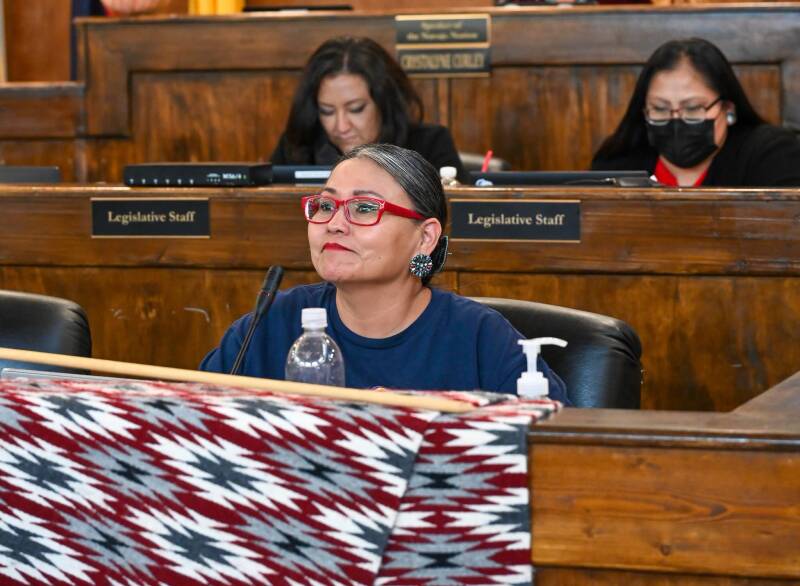
WINDOW ROCK, Ariz. — The 25th Navajo Nation Council has approved legislation aimed at protecting the honor and legacy of Diné veterans and Navajo Code Talkers by establishing the Diné Stolen Valor Act.
Approved on Wednesday through the Council's consent agenda, Legislation No. 0180-26 would amend Title 17 of the Navajo Nation Code to create criminal and civil penalties for individuals who falsely claim military service, military honors, combat experience, veteran status, or association with the Navajo Code Talkers for personal gain.
The legislation was sponsored by Eugenia Charles-Newton and co-sponsored by Nathan Notah.
"Our Diné veterans and Navajo Code Talkers have served with courage, sacrifice and honor, and their service deserves our highest respect," Charles-Newton said. "No one should be allowed to falsely claim military service or exploit the legacy of our warriors for personal gain."
Under the proposed law, individuals who knowingly misrepresent military service or Code Talker status in order to obtain money, employment, property, contracts, benefits, or other tangible gains could face criminal prosecution.
The measure also provides special protections for the legacy of the Navajo Code Talkers, whose use of the Diné language during World War II played a vital role in secure military communications.
If enacted, the Diné Stolen Valor Act would prohibit individuals from:
- Falsely claiming to be a Navajo Code Talker.
- Falsely claiming to be a family member or official representative of a Code Talker.
- Soliciting donations, compensation, or benefits through fraudulent claims of Code Talker affiliation.
- Misrepresenting military rank, awards, decorations, combat service, or veteran status for personal gain.
Notah said the legislation is necessary to protect both veterans and the resources intended for them.
"Our veterans earned their recognition and benefits through honorable service, and we have a responsibility to protect what they sacrificed for," Notah said.
The Navajo Nation administers a variety of programs and benefits for veterans and their families, including scholarships, housing assistance, employment preferences, contracting opportunities, and trust fund programs. Supporters of the legislation argued that fraudulent claims can divert resources away from veterans who legitimately earned those benefits.
Modeled in part after the federal Stolen Valor Act of 2013, the Navajo Nation measure expands protections by specifically addressing fraudulent claims involving Navajo veterans and the Navajo Code Talkers.
Under the legislation, violators could face:
- Up to one year in jail.
- Fines of up to $5,000.
- Restitution payments.
- Forfeiture of fraudulently obtained benefits.
The legislation also allows veterans, families, organizations, and Navajo Nation programs harmed by fraudulent claims to pursue civil remedies.
To protect free speech and legitimate activities, the proposal requires proof that an individual knowingly made a false claim with the intent to obtain a tangible benefit. Historical reenactments, educational programs, journalism, artistic performances, ceremonial recognition, and truthful statements would remain protected under the law.
The proposal originated after the Northern Navajo Veterans Organization requested stronger legal protections against stolen valor and fraudulent claims involving veterans' benefits.
The legislation passed unanimously with a vote of 21-0.
The measure now moves to the Office of the President and Vice President, where Buu Nygren will have ten days to sign, veto, or allow the legislation to become law without a signature.
If enacted, the Diné Stolen Valor Act would become one of the strongest tribal laws in the country aimed at protecting the integrity and legacy of Indigenous military service.
Create Your Own Website With Webador